
LEGACY pools
Company Name: Legacy Pools
Likely Relations: Kristin Black
Company Owner: Charles "Chad" David Black
Licensed?: No
License State: FL
License Number: CPC1459154
CURRENT STATUS: Relinquishment (02/2025), ARRESTED ON BAIL
Company Name:
Likely Relations:
Company Owner:
Licensed?:
License State:
License Number:
CURRENT STATUS:
Legacy Pools
Kristin Black
Charles "Chad" David Black
No
FL
CPC1459154
Relinquishment (02/2025), ARRESTED ON BAIL
“Legacy Pools”
• Consumers allege payments made & pools not started or incomplete
• License relinquished by DBPR February, 2025
• Over 600 alleged victims in Florida
• BBB "F" rating
Our advice: pause all payments, document the site, and contact your state licensing board and police immediately.
Over 600 victims, totalling over $4 million in losses
Legacy Pools Florida Fraud: How Unfinished and Never-Built Pools Devastated Homeowners
Thinking about building a backyard pool in Florida? Before you sign a contract or hand over a deposit, learn from the devastating Legacy Pools Florida fraud case so you do not become the next victim of unfinished or completely not built pools.
What Happened in the Legacy Pools Florida Fraud Case?
Legacy Pools, LLC, owned by Charles “Chad” Black and Kristin Black, operated across Central Florida, including Brevard, Orange, and Osceola counties. Over several years, the company allegedly collected large deposits from homeowners for swimming pools that were left as unfinished pools or, in many cases, completely not built pools at all. Investigations and legal filings suggest the scheme affected hundreds of families and involved millions of dollars in losses (Service Industry News, 2024).
According to court documents and news reports, the Blacks allegedly used customer deposits for personal luxuries such as travel, vehicles, clothing, and even improvements to their own property instead of building the promised pools (FOX 35 Orlando, 2025). In 2025, they were arrested in Arizona and extradited to Florida on charges including an organized scheme to defraud, with authorities estimating more than 300 victims and at least $2 million in losses (WFTV, 2025).
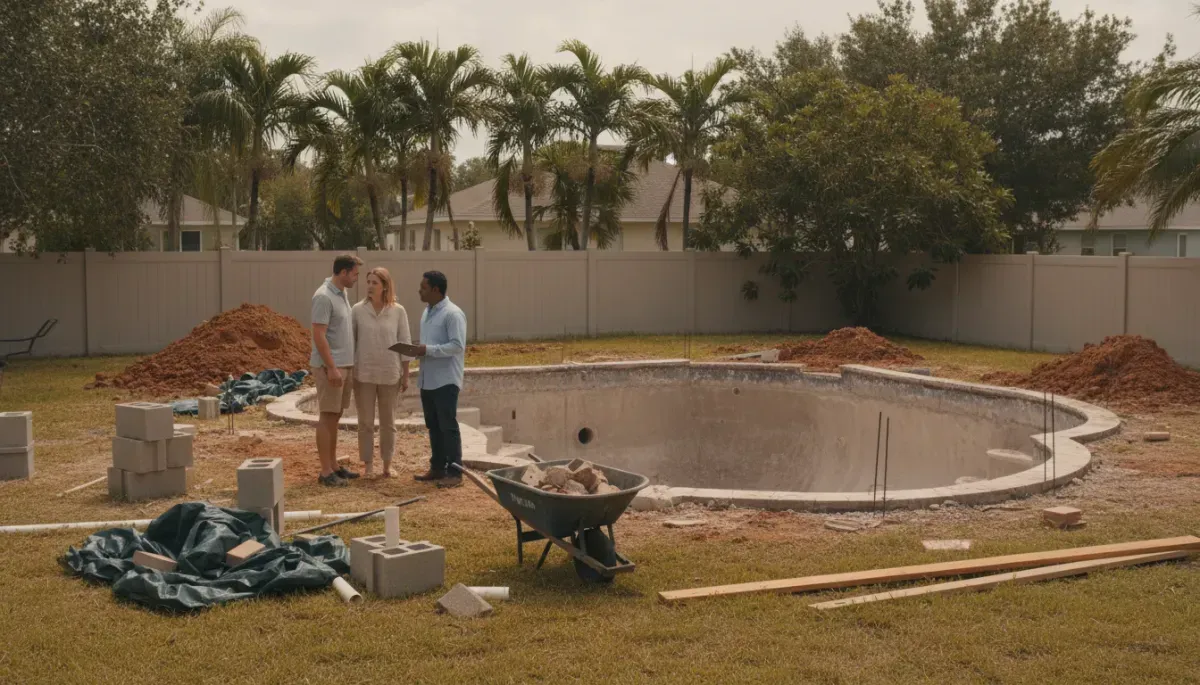
Unfinished Pools: Torn-Up Yards and Broken Promises
For many Legacy Pools customers, the nightmare began after a large deposit was paid. Crews might show up, dig a hole, or pour a partial shell—then disappear. Homeowners were left with unfinished pools, unsafe construction sites, and no clear answers. One Cocoa Beach homeowner reportedly paid over $92,000 and then had to spend an additional $62,000 to hire another company to complete the project (Service Industry News, 2023).
Others described months of silence, poor workmanship, and repeated broken promises about “next week” or “waiting on permits.” A Melbourne homeowner told FOX 35 that after paying a $60,000 down payment, progress stalled for more than 100 days, calling it the “biggest regret” of his life (FOX 35 Orlando, 2023). These stories are not rare outliers—they match a pattern documented in dozens of complaints and lawsuits.
Many families were left with dangerous, half-dug pits and no working pool.
Completely Not Built Pools: Paying for a Dream That Never Started
Some customers of Legacy Pools Florida experienced an even harsher reality: they paid huge deposits for pools that were completely not built. In these cases, there was no excavation, no permits pulled, and sometimes not even materials delivered—just contracts, broken promises, and vanished money. Scam alerts in 2026 noted that Legacy Pools collected more than $2 million in deposits from over 300 homeowners while failing to build the pools they promised (OnlyTopic, 2026).
Florida law is clear: contractors are generally prohibited from taking more than 10% of the contract price—or $1,000, whichever is less—as an initial deposit before certain steps, like pulling permits, are completed. Yet Legacy Pools allegedly demanded deposits far beyond those limits, a major red flag that consumers often did not realize violated state law (OnlyTopic, 2026).
Bankruptcy, Criminal Charges, and What It Means for Victims
In 2022, Legacy Pools filed for Chapter 11 bankruptcy, which was later converted to Chapter 7 liquidation in 2023 (RKC Law, 2022; GovInfo, 2023). A Chapter 7 trustee has been working to identify and sell any remaining assets to distribute to creditors, including homeowners who filed claims. LegalClarity reported that a final report was filed in September 2025, signaling that any remaining funds are limited and will be split among many victims (LegalClarity, 2025).
Criminal charges against Chad and Kristin Black are still moving through the courts as of early 2026. While criminal cases can bring accountability and potential restitution, they rarely make homeowners financially whole. Many families have had to refinance homes, drain savings, or abandon the idea of a pool altogether just to recover from the damage caused by the Legacy Pools Florida fraud.
How to Protect Yourself From Pool Contractor Fraud in Florida
The Legacy Pools case is a powerful warning for any homeowner considering a major backyard project. Here are practical steps to help ensure you never face unfinished or completely not built pools in your own yard:
Verify the contractor’s license. Use the Florida Department of Business and Professional Regulation (DBPR) website to confirm the license is active, properly classified, and free of major disciplinary actions.
Check complaint history. Search the contractor’s name on the DBPR site, the Better Business Bureau, and local court records. Multiple unresolved complaints or lawsuits are a serious warning sign.
Never pay large upfront deposits. In Florida, deposits are generally capped at 10% or $1,000 before permits. Anyone demanding 30–50% or more up front should be treated with extreme caution.
Insist on clear, written contracts. The agreement should spell out payment schedules tied to specific milestones, permit responsibilities, start and completion dates, and what happens if deadlines are missed.
Visit recent job sites. Speak directly with homeowners whose pools were completed in the last 6–12 months. Ask how communication, timelines, and quality of work were handled.
💡 Pro Tip: If a contractor pressures you to “sign today” for a special price, or becomes defensive when you ask to verify their license and references, treat that as a major red flag and walk away.
What to Do If You Think You’re a Victim
If your pool project has stalled or your contractor has disappeared, act quickly. Document everything—contracts, checks, bank statements, text messages, emails, and photos of the job site. Then:
Consult a construction or consumer protection attorney to understand your options, including breach-of-contract and fraud claims.
File complaints with the Florida Attorney General’s Office (MyFloridaLegal.com or 1‑866‑9‑NO‑SCAM) and the DBPR so regulators can track patterns of abuse.
Contact your local building department to verify what permits, if any, were actually pulled in your name.
⚠️ Important: This article is for general informational purposes only and is not legal advice. If you suspect fraud or have an unfinished or completely not built pool, speak with a qualified attorney about your specific situation.
Final Word: Let the Legacy Pools Story Be Your Warning
The Legacy Pools Florida fraud case shows how quickly a dream backyard can turn into a financial and emotional disaster. By understanding what happened—unfinished pools, completely not built pools, and millions of dollars in alleged fraud—you can better recognize the warning signs in your own contractor search. Take your time, verify everything, and never be afraid to walk away. Protecting your home and your savings is far more important than any “limited-time” pool deal.
Victim Public Comment Forum
Public Comment Disclaimer
Comments on this page are submitted by third parties and do not represent the views of Contractor Alert.
By submitting content, users represent and warrant that their statements are truthful, based on personal experience or clearly stated opinion, and do not violate any applicable laws, including those related to defamation.
Contractor Alert is a neutral platform and does not endorse or verify user-submitted content. All liability for posted material remains with the individual user.
Contractor Alert reserves the right to review, moderate, remove, or preserve content.
Prohibited Content:
1. Allegations of criminal activity unless supported by: a police report number a filed lawsuit (case number) or verifiable public record.
2. Statements claiming someone is/committed a “Scam / Scammer”, “Fraud / Fraudulent”, “Theft / Thief / Stole”, “Criminal”, “Ponzi scheme”etc. without documented evidence.
3. Threats, harassment, or abusive language.
4. Posting personal information (addresses, phone numbers, family details).
5. False or misleading statements presented as fact.
6. Statements made on behalf of others (must be first-hand experience only).
How to Post Safely:
1. Speak from your own experience only.
2. Use phrases like: “In my experience…” “I paid $X on [date] and have not received…”.
3. Avoid conclusions about intent (e.g., don’t say “they stole,” say what happened).